
About the Artist
 Heather Timm's work blurs boundaries between material and digital realities. She might paint with an image, animate a painting, or build a sculpture that only exists in virtual reality. She approaches each new idea as an open field of potential rather than a fixed outcome. She calls this practice "quantum kinship" — a belief, drawn from both ancestral knowledge systems and quantum physics, that nothing exists in isolation. Every artwork is a momentary collapse of infinite, interconnected possibilities.
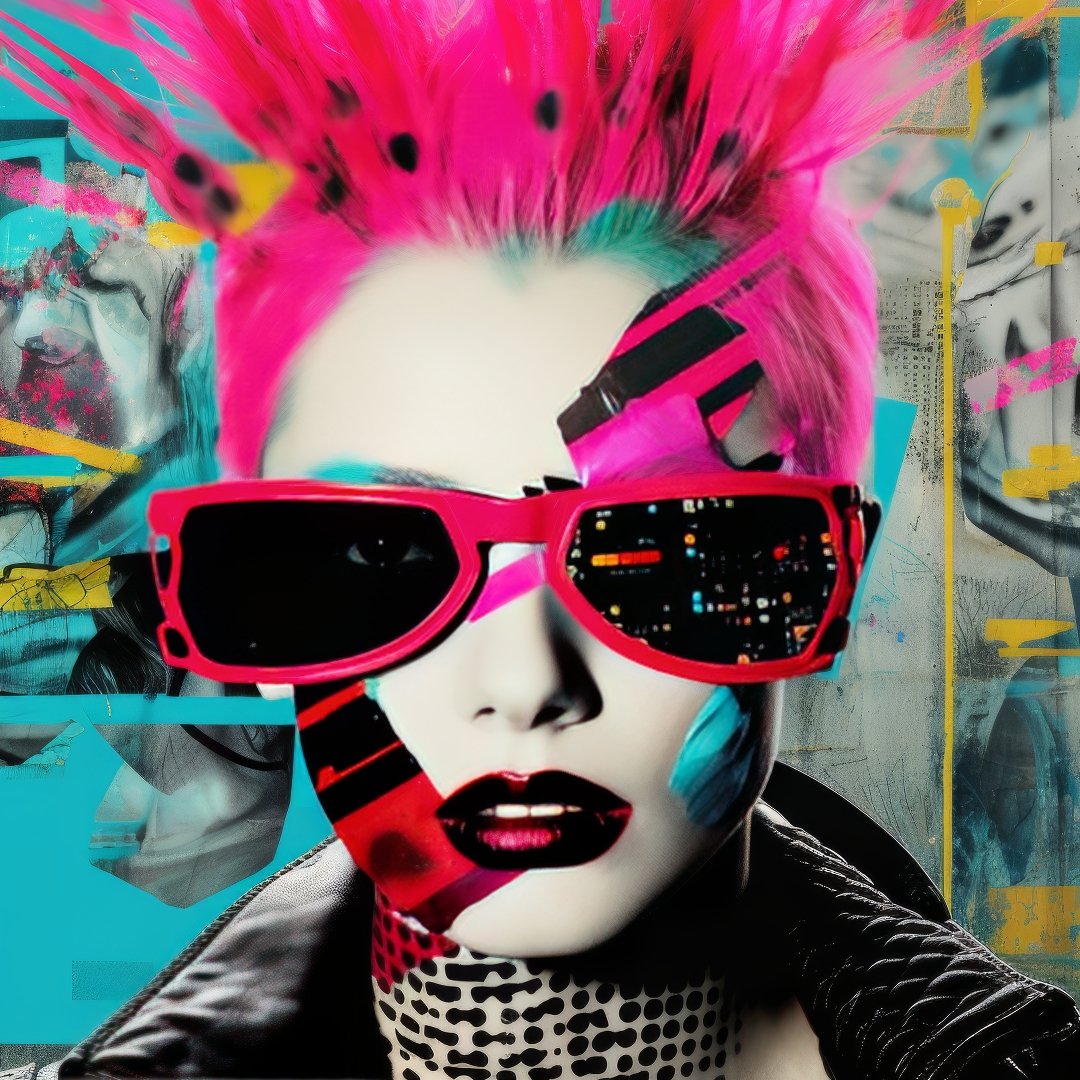 Based in Seattle, Heather's work has been exhibited at the United Nations Summit of the Future, UN Sustainable Development Goals Awards in Rome, Grand Palais Éphémère Paris, Scope Art Show Miami, Lume Studios NYC, MaMa Multimedia Institute Zagreb, University of Chicago Media Arts, Data, and Design Center, and numerous galleries and street art locations. She is the recipient of dotART's 2025 International Artists Day Grand Prize. Her circuit-bent photography was selected by National Geographic award-winning photographers John Knopf and Michael Yamashita for inclusion in a coffee table book highlighting 100 exceptional photographers shaping the future of art and creativity.
Artist Statement
We live in a time that is veering away from wisdom, balance, and nature, toward a desire for singular truth, fixed identity, consolidated power, and predictable outcomes. Surveillance capitalism, biometric tracking, and algorithmic control all assume you are one knowable thing that can be predicted, monetized, and contained.
My creative practice refuses this. I bridge computational systems with indigenous and ancestral relational wisdom. I choose cyclical time over linear progress, non-binary being over forced categorization, invisible kinship over visible borders. I find freedom in glitch and error. After all, error is relative to the system in control.
Everything I make is a collaboration with creation itself: material and spiritual, seen and unseen. As each person views my art, they co-create with me and bring new meaning that, in turn, deepens my own understanding of the work and myself.
I use and interrogate emerging technologies as sites of possibility. Technology is not neutral—it can control or liberate, depending on who wields it and toward what ends. In my series The Art of Protest circuit-bent cameras document protests and street life, their corrupted sensors fragmenting faces into unrecognizable pixels—corruption protecting people from the corruption of surveillance capitalism and facial recognition. In Recoded, I transform digital art back into ASCII, making infrastructure visible, celebrating when code doesn't hide.
My sculpture work makes the body a site of freedom, political argument, and ecological kinship. In Colonized!, a female torso is wrapped in world maps. The borders of nations are draped over the curves of a body, collapsing the distance between geopolitical control and bodily autonomy. The logic is the same: extract, divide, contain, own. Mother of Us All extends this further: a pelvis cradling the Earth in the birth canal, insisting that the land is not a resource to be managed but a body to be carried and born from, cared for, nurtured. All You Are to Them turns the gaze on the present tense: a glass case layered with international currency, a disembodied hand holding a smartphone, scattered eyeballs. It is the complete inventory of what surveillance capitalism actually wants from you. Against all of this, This Is Your Brain on Art proposes something different. The skull is open. A figure moves inside a third eye. This is the knowing that lives beyond words, beyond measurement. It is insight as embodied, relational, and stubbornly free.
When you encounter my work, I hope you walk away feeling something: surprise, curiosity, delight, maybe discomfort. The work spans enough terrain that what resonates will be different for each person. Some connect with the humor. Others with political critique. Still others with pure aesthetic experience. What matters is that something shifts, that you leave having connected in some way.
Quantum Kinship is my practice.
Connection is my goal.
Curiosity is my constant.